Year 8 Mathematics

Volume of prisms and cylinders, and capacity

Two worked questions, each with its solution and marking guidelines.

  • Questions at easy and medium levels
  • As short answer and multiple choice
  • Some with diagrams
  • New numbers every time, from 5,000+ templates across NSW Years 7 to 12

Two worked examples

Question 11 markEasier

A can is a cylinder with a radius of 77 cm and a height of 1111 cm, as shown in the diagram. Use π≈3.14\pi \approx 3.14. What is the volume of the can, in cubic centimetres?
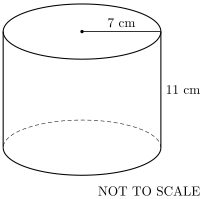
Figure

Worked solution

V=πr2h≈3.14×72×11V = \pi r^2 h \approx 3.14 \times 7^2 \times 11

V=3.14×49×11=1692.46V = 3.14 \times 49 \times 11 = 1692.46 cubic centimetres

Answer

1692.461692.46

Marking guidelines

Squares the radius and multiplies by pi and the height

1 mark

Report a problem with this question.

Question 21 markMedium

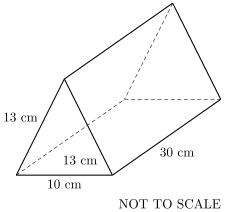
A door wedge is a triangular prism. Each end is an isosceles triangle with a base of 1010 cm and two equal sides of 1313 cm. The wedge is 3030 cm long, as shown in the diagram. Find the volume of the wedge, in cubic centimetres.

Figure

Worked solution

Half of the base is 10÷2=510 \div 2 = 5 cm. Height2=132−52=169−25=144^2 = 13^2 - 5^2 = 169 - 25 = 144, so the height is 1212 cm.

Area of the triangle =12×10×12=60= \dfrac{1}{2} \times 10 \times 12 = 60 cm².

Volume =60×30=1800= 60 \times 30 = 1800 cm³.

Answer

18001800

Marking guidelines

Uses Pythagoras to find the height of the triangle, then multiplies the area of the triangle by the length

1 mark

Report a problem with this question.

Not affiliated with NESA.