Year 9 Mathematics

Congruent and similar triangle conditions

Two worked questions, each with its solution and marking guidelines.

  • Questions at easy and medium levels
  • As short answer and multiple choice
  • Some with diagrams
  • New numbers every time, from 5,000+ templates across NSW Years 7 to 12

Two worked examples

Question 12 marksEasier

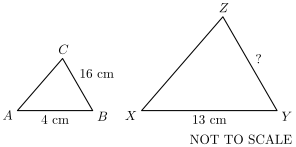
Triangle ABCABC is similar to triangle XYZXYZ, with A↔XA\leftrightarrow X, B↔YB\leftrightarrow Y and C↔ZC\leftrightarrow Z. Given AB=4AB=4, BC=16BC=16 and XY=13XY=13, find the length of YZYZ.

Figure

Worked solution

Since △ABC∼△XYZ\triangle ABC\sim\triangle XYZ with A↔XA\leftrightarrow X, B↔YB\leftrightarrow Y, C↔ZC\leftrightarrow Z: ABXY=BCYZ\dfrac{AB}{XY}=\dfrac{BC}{YZ}.

413=16YZ\dfrac{4}{13}=\dfrac{16}{YZ}, so YZ=16×134=52YZ=\dfrac{16\times13}{4}=52.

Answer

5252

Marking guidelines

Sets up the ratio of corresponding sides AB:XY equal to BC:YZ

1 mark

Solves for YZ, fully simplified

1 mark

Report a problem with this question.

Question 23 marksMedium

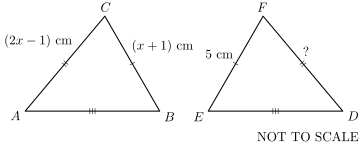
The two triangles in the diagram are congruent, and sides with the same number of ticks are equal. In triangle ABCABC, BC=(x+1) cmBC = (x + 1)\text{ cm} and CA=(2x−1) cmCA = (2x - 1)\text{ cm}. In triangle DEFDEF, EF=5 cmEF = 5\text{ cm}. Find the length of FDFD.

Figure

Worked solution

The triangles are congruent, and BCBC and EFEF carry the same number of ticks, so BC=EFBC = EF: x+1=5x + 1 = 5.

x=5−1=4x = 5 - 1 = 4.

FDFD matches CACA, so FD=2(4)−1=7 cmFD = 2(4) - 1 = 7\text{ cm}.

Answer

7 cm7\text{ cm}

Marking guidelines

Matches BCBC with EFEF using the ticks and forms an equation

1 mark

Solves the equation for xx

1 mark

Matches FDFD with CACA and substitutes to find its length

1 mark

Report a problem with this question.

Not affiliated with NESA.