Year 9 Mathematics

Geometric reasoning and proof with parallel lines, triangles and polygons

Two worked questions, each with its solution and marking guidelines.

  • Questions at easy and medium levels
  • As short answer and multiple choice
  • Some with diagrams
  • New numbers every time, from 5,000+ templates across NSW Years 7 to 12

Two worked examples

Question 13 marksEasier

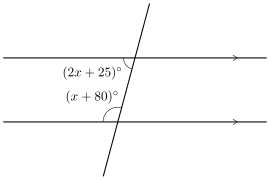
In the diagram, the two horizontal lines are parallel. The two marked angles are (2x+25)∘(2x + 25)^\circ and (x+80)∘(x + 80)^\circ. Find the size of the angle marked (x+80)∘(x + 80)^\circ.

Figure

Worked solution

The marked angles are co-interior angles on parallel lines, so they add to 180∘180^\circ: (2x+25)+(x+80)=180(2x+ 25)+(x+ 80)=180.

3x=753x=75, so x=25x=25.

The angle is (25+80)∘=105∘(25+ 80)^\circ=105^\circ.

Answer

105∘105^\circ

Marking guidelines

Recognises the co-interior angles and forms the equation that they add to a straight angle

1 mark

Solves the equation for the unknown

1 mark

Substitutes to find the size of the angle

1 mark

Report a problem with this question.

Question 23 marksMedium

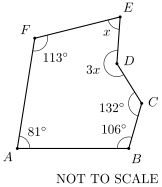
In the hexagon ABCDEFABCDEF shown, the angles at AA, BB, CC and FF are 81∘81^\circ, 106∘106^\circ, 132∘132^\circ and 113∘113^\circ. The angle at EE is xx and the reflex angle at DD is 3x3x. Find the value of xx.

Figure

Worked solution

The angles of a hexagon add up to 720∘720^\circ, so 81+106+132+x+113+3x=72081+ 106+ 132+x+ 113+3x=720.

4x+432=7204x+ 432=720, so 4x=2884x=288.

x=72∘x=72^\circ.

Answer

72∘72^\circ

Marking guidelines

Uses the sum of the interior angles of a hexagon to form an equation

1 mark

Collects the terms in the unknown

1 mark

Solves to find the unknown angle

1 mark

Report a problem with this question.

Not affiliated with NESA.