Year 9 Mathematics

Pythagoras' theorem in three dimensions

Two worked questions, each with its solution and marking guidelines.

  • Questions at medium levels
  • As short answer and multiple choice
  • Some with diagrams
  • New numbers every time, from 5,000+ templates across NSW Years 7 to 12

Two worked examples

Question 12 marksMedium

A cuboid ABCDEFGHABCDEFGH has a rectangular base ABCDABCD with AB=8AB = 8 cm and BC=13BC = 13 cm, and vertical edge CG=4CG = 4 cm. Find the length of the diagonal AGAG in centimetres. Give your answer correct to 2 decimal places.
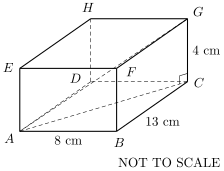
Figure

Worked solution

AC2=82+132=233AC^2 = 8^2 + 13^2 = 233

AG2=AC2+CG2=233+42=249AG^2 = AC^2 + CG^2 = 233 + 4^2 = 249, so AG=249≈15.78AG = \sqrt{249} \approx 15.78 cm

Answer

15.7815.78

Marking guidelines

Finds the diagonal of the base using Pythagoras' theorem

1 mark

Uses Pythagoras' theorem in the vertical triangle to find the diagonal

1 mark

Report a problem with this question.

Question 23 marksMedium

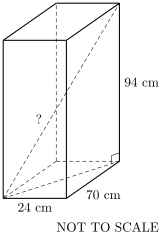
A removalist's closed cardboard carton is a rectangular box measuring 2424 cm by 7070 cm by 9494 cm inside. Find the length of the longest straight rod that can lie inside the carton, in cm, correct to 1 decimal place.

Figure

Worked solution

The longest straight rod is the space diagonal dd, and d2d^2 is the sum of the squares of the three dimensions.

d2=242+702+942=14312d^2 = 24^2 + 70^2 + 94^2 = 14312

d=14312≈119.633d = \sqrt{14312} \approx 119.633, which is 119.6119.6 cm correct to 1 decimal place.

Answer

119.6119.6

Marking guidelines

Sums the squares of the three dimensions

1 mark

Takes the square root to find the space diagonal

1 mark

Gives the length to one decimal place

1 mark

Report a problem with this question.

Not affiliated with NESA.