
Year 9 Mathematics

Two-step experiments with arrays and tree diagrams

Two worked questions, each with its solution and marking guidelines.

  • Questions at easy and medium levels
  • As short answer and multiple choice
  • Some with diagrams
  • New numbers every time, from 5,000+ templates across NSW Years 7 to 12

Two worked examples

Question 12 marksMedium

The diagram shows Bag A and Bag B, each marble being marked R (red) or B (blue). Bag A holds 1 red marble. One marble is taken at random from each bag. Find the probability that the two marbles are different colours. Give your answer as a fraction in simplest form.
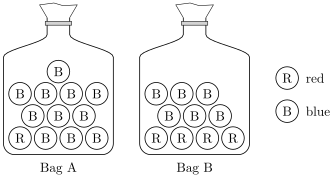
Figure

Worked solution

From the diagram, Bag A has 11 red and 1111 blue marbles (1212 in all) and Bag B has 44 red and 66 blue (1010 in all).

P(different)=112×610+1112×410=50120=512P(\text{different}) = \dfrac{1}{12}\times\dfrac{6}{10} + \dfrac{11}{12}\times\dfrac{4}{10} = \dfrac{50}{120} = \dfrac{5}{12}

Answer

512\dfrac{5}{12}

Marking guidelines

Reads the counts from the diagram and finds the probability of each of the two ways of getting different colours

1 mark

Adds the two probabilities and simplifies

1 mark

Report a problem with this question.

Question 23 marksMedium

The probability that it rains on Saturday is 0.420.42 and the probability that it rains on Sunday is 0.620.62. The two days are independent. Find the probability that it rains on exactly one of the two days. Give your answer correct to 2 decimal places.

Worked solution

P(exactly one)=p×(1−q)+(1−p)×qP(\text{exactly one}) = p \times (1 - q) + (1 - p) \times q with p=0.42p = 0.42, q=0.62q = 0.62

=0.42×0.38+0.58×0.62=0.1596+0.3596= 0.42 \times 0.38 + 0.58 \times 0.62 = 0.1596 + 0.3596

≈0.52\approx 0.52

Answer

0.520.52

Marking guidelines

Identifies the two ways of raining on exactly one day

1 mark

Multiplies the probabilities along each way

1 mark

Adds the two results

1 mark

Report a problem with this question.

Not affiliated with NESA.